There is a version of fire safety that lives entirely on paper. Certificates filed. Statements lodged. Boxes ticked. And then there is the version that actually matters, the one where every alarm, door, extinguisher and exit light in your building works correctly when it needs to.
Fire safety inspections are the mechanism that connects those two versions. Done properly, they are not an administrative exercise. They are a physical confirmation that the systems protecting your building and the people inside it are operational, not just documented.
Understanding what an inspection covers and what happens when it does not happen is genuinely useful for any property owner or facilities manager in Australia.
The Gap Between Owning a Building and Knowing It Is Safe
Here is something that does not get said enough. A building that passed its inspection eighteen months ago is not a fire-safe building today. It is a building that was compliant eighteen months ago.
Systems degrade. Smoke alarms lose sensitivity. Extinguisher pressure bleeds off. Fire doors get damaged, and nobody reports it. Sprinkler heads get painted over during a fit-out. Exit lights lose their battery backup without triggering any visible fault indicator.
None of these failures announce themselves. They accumulate quietly until a scheduled fire safety inspection finds them, or until a fire does.
That is the actual argument for regular inspections. Not compliance for its own sake. The physical state of your systems.
So What Does a Proper Inspection Cover
The scope of an inspection depends on what is listed on a building’s fire safety schedule, the formal document that nominates which fire safety measures the council recognises for that property. Different buildings carry different nominated measures. A small retail tenancy looks different to a twelve-storey office block.
That said, most commercial and residential inspections will cover some combination of the following:
- Smoke and heat detection: Each detector checked for sensitivity, placement relative to current Australian Standards, and physical condition. The main fire indicator panel tested for faults and correct zone mapping
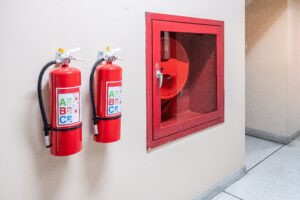
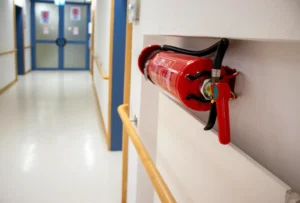
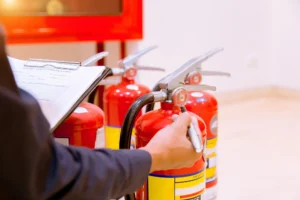
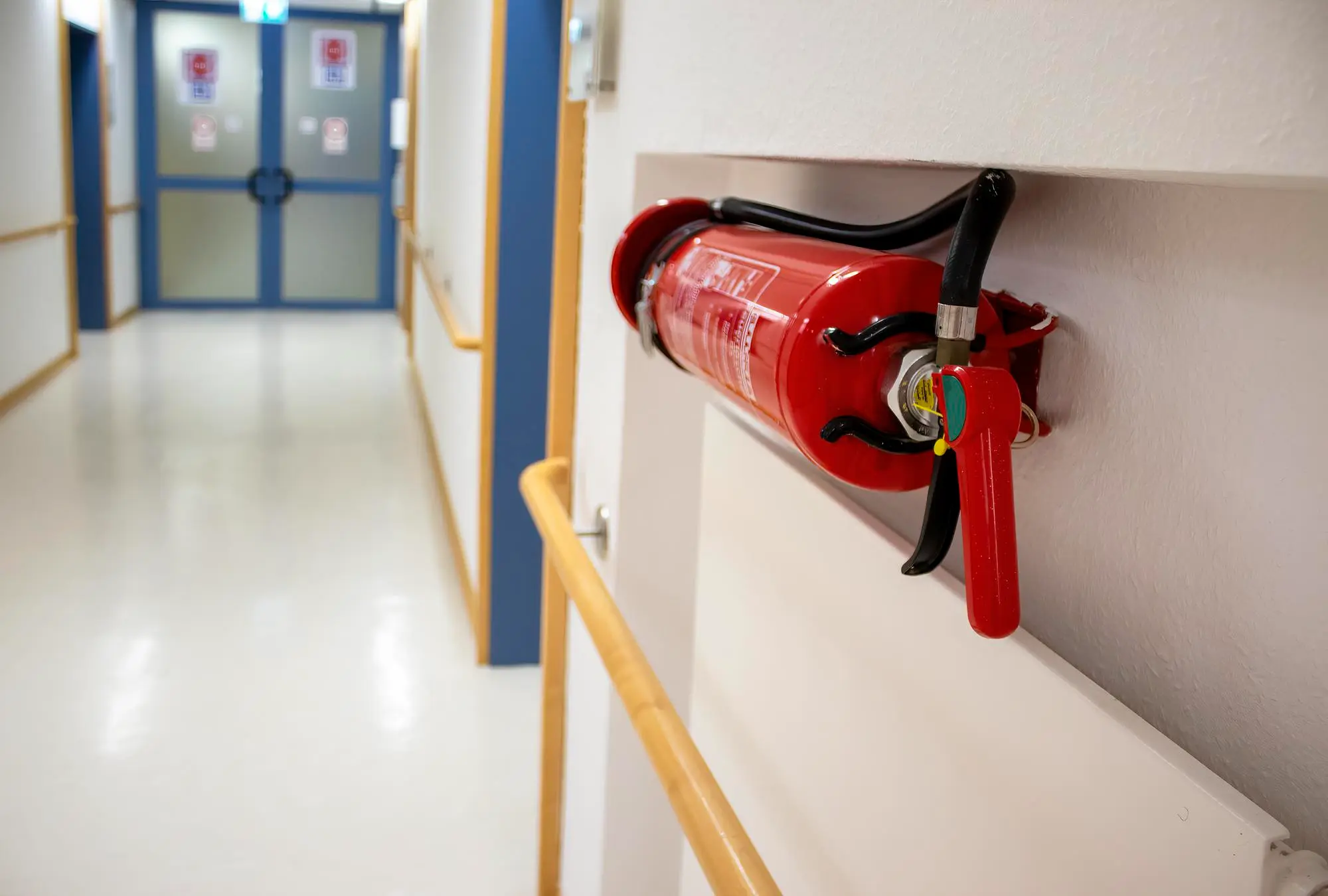
- Fire extinguishers: Pressure readings verified, physical condition assessed, service tags checked for currency, and type confirmed as appropriate for the hazard zone it covers
- Emergency and exit lighting: Battery backup tested under load conditions, luminance levels assessed, signage legibility confirmed
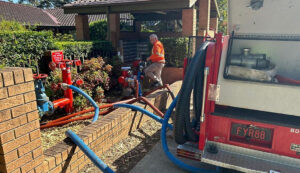
- Fire hose reels and hydrants: Flow and pressure tested, cabinet condition checked, accessibility verified
- Sprinkler systems: Heads inspected for obstruction, correct orientation, and corrosion. Control valves checked for correct position
- Fire doors: Self-closing mechanisms, intumescent seals, clearance gaps, and signage all assessed. This is an area where buildings accumulate defects quietly over time.
- Evacuation routes: Path clearance, floor markings, and directional signage reviewed against the current evacuation diagram
- Electrical safety switches: RCDs manually tripped and confirmed for correct operation
At the end of this process, the inspector issues either a compliance certificate or a defect report. The defect report is a more useful outcome in many ways. It tells you exactly what is wrong before you submit an Annual Fire Safety Statement that may not reflect the actual state of the building.
Why the Annual Cycle Matters as Much as the Inspection Itself
One inspection is useful. A consistent annual cycle is what builds a reliable record of how your building’s systems are performing over time.
An annual fire safety inspection in Sydney gives you something a one-off check cannot: a baseline, a comparison point, and a documented history of how defects have been found and resolved. That history matters to insurers when claims are assessed, to council when compliance disputes arise, and to potential commercial tenants with ESG or due diligence requirements.
Property owners who treat fire safety inspections as a recurring discipline rather than a yearly inconvenience tend to spend less on emergency rectifications. Problems get caught early when they are cheap to fix, not when they have compounded into something structural.
Choosing Who Does the Work
When evaluating fire safety companies nearby, the certificate at the end is not the only thing worth assessing. The methodology behind it matters considerably more.
Ask whether the provider issues full defect reports with photographic evidence, or whether they simply pass or fail the inspection without written detail. Ask whether they hold current FPAS accreditation or the relevant NSW fire safety practitioner licence. Ask whether they can service all the measures on your schedule, or whether you will need to coordinate multiple contractors for a complete inspection.
A provider who documents defects properly and follows up on rectification is doing the job correctly. One who finds no defects consistently, across a building that has not had maintenance work done, is worth questioning.
The Part Most People Don’t Think About Until It Is Too Late
Missing an annual fire safety inspection in Sydney deadline is not a minor paperwork gap. Under the Environmental Planning and Assessment Regulation 2021, local councils in NSW have enforcement powers that include issuing penalty notices, and for corporations, those penalties are not trivial.
Beyond the regulatory exposure, the insurance dimension is the one that catches property owners off guard. An insurer assessing a fire claim at a property with a lapsed AFSS will scrutinise that lapse. The outcome of that scrutiny is rarely in the property owner’s favour.
The inspection is not expensive relative to what it protects. That calculus is worth keeping in mind every twelve months.
Priority Fire Systems provides fire safety inspections across residential, commercial, aged care, hospitality, and industrial properties throughout Sydney.