Most property owners in Sydney think about fire compliance once a year, right around the time their managing agent
sends a reminder or the council posts a notice. That reactive approach works, until it doesn’t.
Fire safety inspections in
Sydney are not just about ticking a box for the council. The inspection is the mechanism by which you confirm, in writing, that the systems protecting your building and the people inside it are actually working. Not assumed to be working. Actually working.
This guide covers what the process involves, what your obligations are depending on your property type, and what
to look for when choosing who does the work.
Start Here: What Triggers the Requirement?
NSW fire safety compliance is governed by the Environmental Planning and Assessment Regulation 2021. The practical
obligation for most building owners is the Annual Fire Safety Statement, submitted to council and displayed at the
premises once every twelve months.
The requirement applies to buildings in Class 2 through Class 9 under the National Construction Code. That is a
wide net.
It covers:
- Apartment buildings and multi-residential properties
- Offices, retail shops, shopping centres
- Hotels, motels, and serviced apartments
- Hospitals and aged care facilities
- Warehouses, factories, and industrial buildings
- Gyms, sporting venues, and schools
If your building has a fire safety schedule, which lists the nominated fire safety measures the council recognises
for that property, you need an annual inspection and statement. No schedule, no AFSS requirement in most cases, but
separate smoke alarm obligations under tenancy law may still apply.
What the Annual Fire Inspection Actually Looks At
People sometimes ask why inspections take as long as they do. The answer is that a proper inspection is not a
single check. It is a systematic review of every nominated safety measure on the schedule, documented with enough
detail to support a formal compliance declaration.
For most commercial properties, that includes:
- Fire detection: smoke alarms, heat detectors, ionisation detectors, and the main
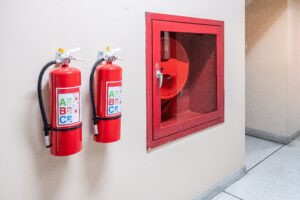
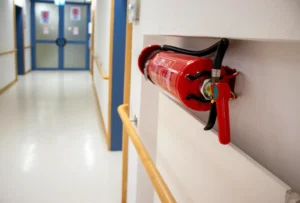
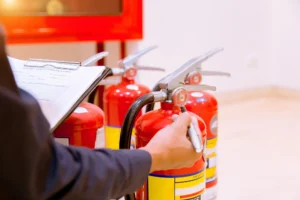
fire indicator panel - Suppression equipment : extinguishers checked for pressure, condition, service tag currency, and correct
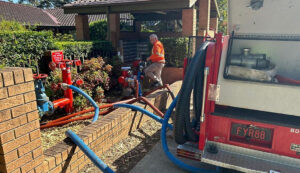
type for the hazard zone - Hose reels and fire hydrants, tested for water flow and operational readiness
- Sprinkler systems if installed, heads inspected for obstruction and correct orientation
- Emergency and exit lighting, including battery backup duration testing
- Fire doors: self-closing mechanisms, intumescent seals, signage, and gap tolerances
- Evacuation routes, ensuring clear paths and legible directional signage
- Electrical safety switches (RCDs) manually tripped and verified
What comes out the other end is either a compliance certificate or a defect report that lists what needs
rectifying before certification can proceed. The defect report is not the bad outcome people assume it is. It is the
inspection doing its job. The worst outcome is a building that gets a clean certificate when it should not.
What Fire Safety Inspections in Sydney Actually Cost
There is no single number here, because the cost depends on what your fire safety schedule includes.
For residential rental properties, annual compliance packages for smoke alarms typically run between $90 and $130
per property. That generally covers testing, battery replacement, a compliance certificate, and an audit report with
photographs. Some providers bundle blind compliance and RCD testing into a combined package at the upper end of that
range.
For commercial properties, pricing gets more variable. A small retail tenancy with basic detection equipment and a
couple of extinguishers is a different job to a four-storey office building with a full sprinkler system, a fire
indicator panel, and pressurised stair shafts. Mid-size commercial buildings in Sydney can expect inspection and
certification costs anywhere from a few hundred to a few thousand dollars annually, depending on system complexity
and floor area.
When you are getting quotes, make sure you are comparing the same scope. A cheaper quote that excludes defect
documentation or rectification reporting will cost more when something needs fixing, and there is no paper
trail.
Choosing Between Fire Safety Companies Nearby
Not all providers operate to the same standard. Licensing, accreditation, and methodology vary more than most
property owners realise until something goes wrong.
When evaluating providers, these are the questions worth asking:
- Are they accredited under FPAS or hold the relevant NSW fire safety practitioner licence?
- Do they provide a defect report with photographic evidence, or just a pass/fail certificate?
- Can they service all the measures on your fire safety schedule, or will you need multiple contractors?
- Do they have experience with your property type? Aged care has different requirements from a warehouse.
- What is their turnaround on the compliance certificate and AFSS lodgement?
The last point matters more than people expect. Council lodgement deadlines are fixed. A provider who inspects
promptly but takes three weeks to issue documentation can still leave you in default.
The Maintenance Piece Most Owners Underestimate
Passing an annual fire inspection is not the same as having a fire-safe building for the twelve months that follow. Systems degrade. Batteries drain. Fire doors get propped open for months by a wedge someone thought was temporary.
The properties that pass inspections without surprises year after year are not just lucky. They have someone with
actual accountability for the system between formal inspection dates. Not a contractor on call. A person with a
schedule who checks things.
Maintenance between inspections is what turns a compliance exercise into genuine building safety.
Fire safety inspections in Sydney will not wait for a convenient time in your calendar. The AFSS lodgement
date is fixed, and the cost of missing it adds up faster than the inspection itself.
Priority Fire Systems covers residential, commercial, aged care, hospitality, and industrial properties across
Sydney and the surrounding areas.